Zen and the Art of Making Samogon: A Survival Guide for the AI Era
On Pirsig, a moonshine still built from copper tubing in Nigerian heat, and why the willingness to look inside things matters more now than ever.
I. Yola, Nigeria, 2008

I first read *Zen and the Art of Motorcycle Maintenance https://www.amazon.com/Zen-Art-Motorcycle-Maintenance-Inquiry/dp/0688002307 * by Robert Pirsig in Yola – a small town in northeastern Nigeria, on the border with Cameroon – where we were teaching and building a world-class institution, the American University of Nigeria, in a location that wasn’t exactly ready for such an undertaking at that time.
I don’t remember how it got into my hands. I’ve since decided that doesn’t matter – what matters is that it keeps meaning something different every time I return to it.
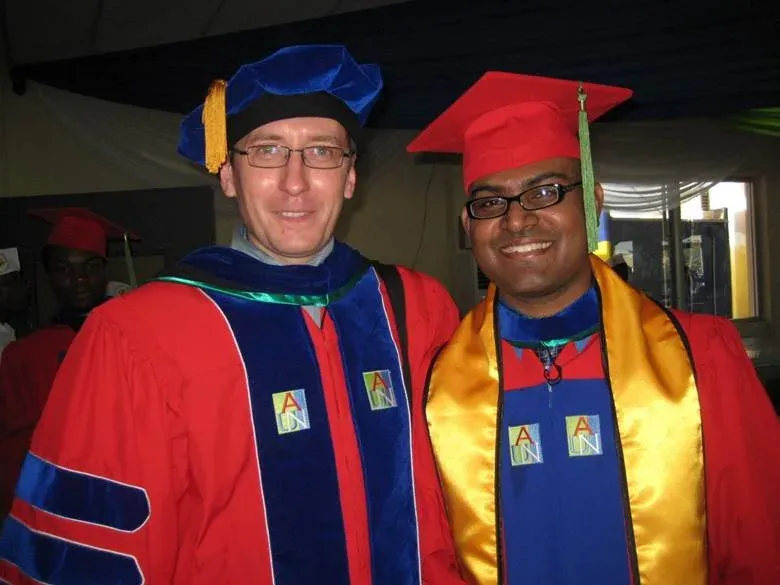
Before anything else, this piece is for the people who were there. To Sergey Butakov , who handed me the ticket, and Amb.Prof.Muhammadou M.O. Kah, Ph.D , who made sure I was worth it. Colleagues from the university – construction workers, staff, faculty, students – who showed up completely, far from home, working on something genuinely hard. And equally for the locals from Yola and the surrounding villages who taught me things no university curriculum ever could. It was a fascinating, even surreal place – where else could you find yourself meeting Nobel laureate Archbishop Desmond Tutu in person, who sat on the university’s founding Board of Trustees, in a small town most people couldn’t locate on a map? There is a particular sweetness to that nostalgia. Not the kind that distorts – the kind that calibrates. A reminder of what it feels like to be surrounded by people with молодецкий задор – that untranslatable Slavic quality of courageous, joyful audacity – in conditions that tested every assumption you arrived with.
Thanks, Hamman Samuel, for letting me use this precious memory as well:
On weekends, between teaching sessions and construction logistics, we were also building a moonshine distillation apparatus from scratch – mango and sugar cane, copper tubing, improvised cooling in forty-degree heat – because Nigerian weather doesn’t care about your recipe, and if you want the result, you have to understand the thermodynamics. You can’t prompt your way through it.
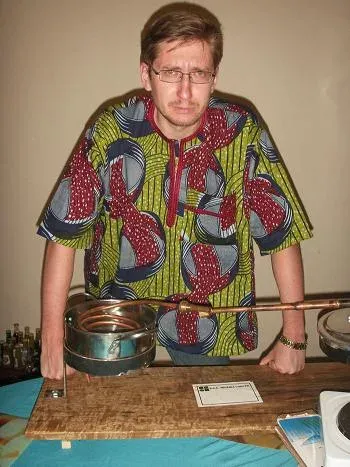
I didn’t know then that I was living the book I was reading.
II. Inside the Machine
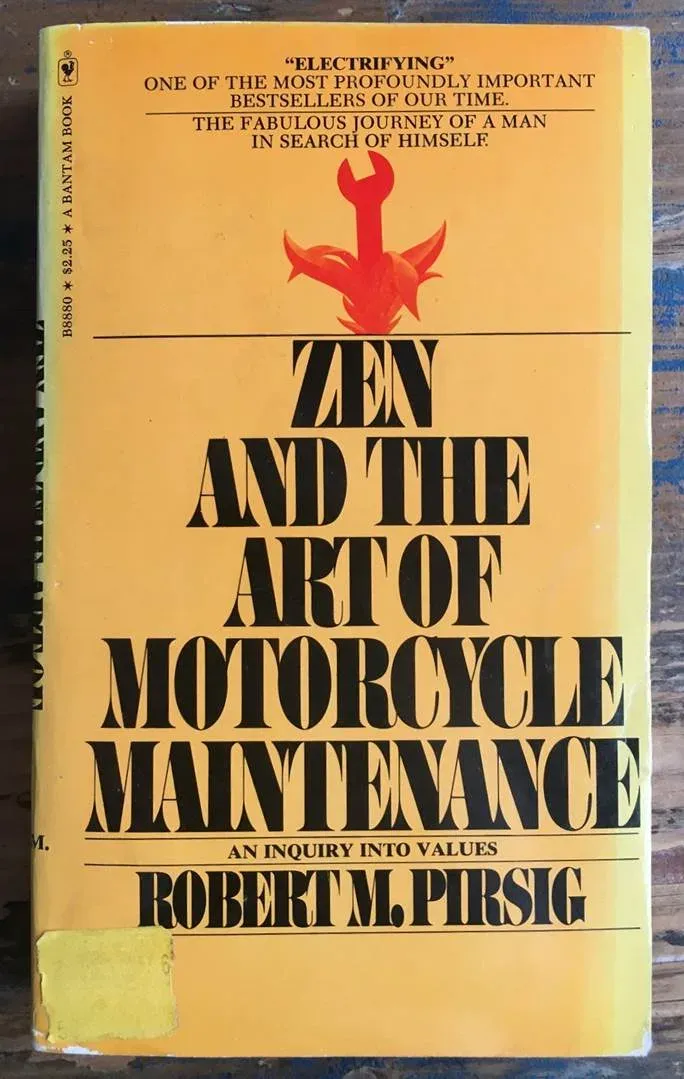
Pirsig travels across America with his son and two friends – John and Sylvia Sutherland. Educated, warm, culturally curious people. But when the motorcycle breaks down, John panics and steps back. He doesn’t want to look inside. The machine is a black box: when it works, it’s invisible; when it breaks, it’s a catastrophe.
The narrator fixes it calmly, methodically. He understands the system.
Pirsig doesn’t judge John. He observes. He sees in that dynamic a cultural fracture: the growing separation between those who understand how things work and those who only use them. The Sutherlands are not stupid. They are disengaged. And disengagement, Pirsig argues, is a form of spiritual poverty – not because you need to fix motorcycles, but because the willingness to look inside things, to understand their internal states, is connected to something deeper about how you inhabit the world.
That fracture has been widening ever since. And AI has just handed it a sledgehammer.
III. The Welding Class
A few months ago, several of my software engineering friends quietly enrolled in a welding class. Nobody announced it. Nobody made it a LinkedIn post. They just sensed something – the same instinct that sends people back to first principles when the ground starts shifting beneath them.
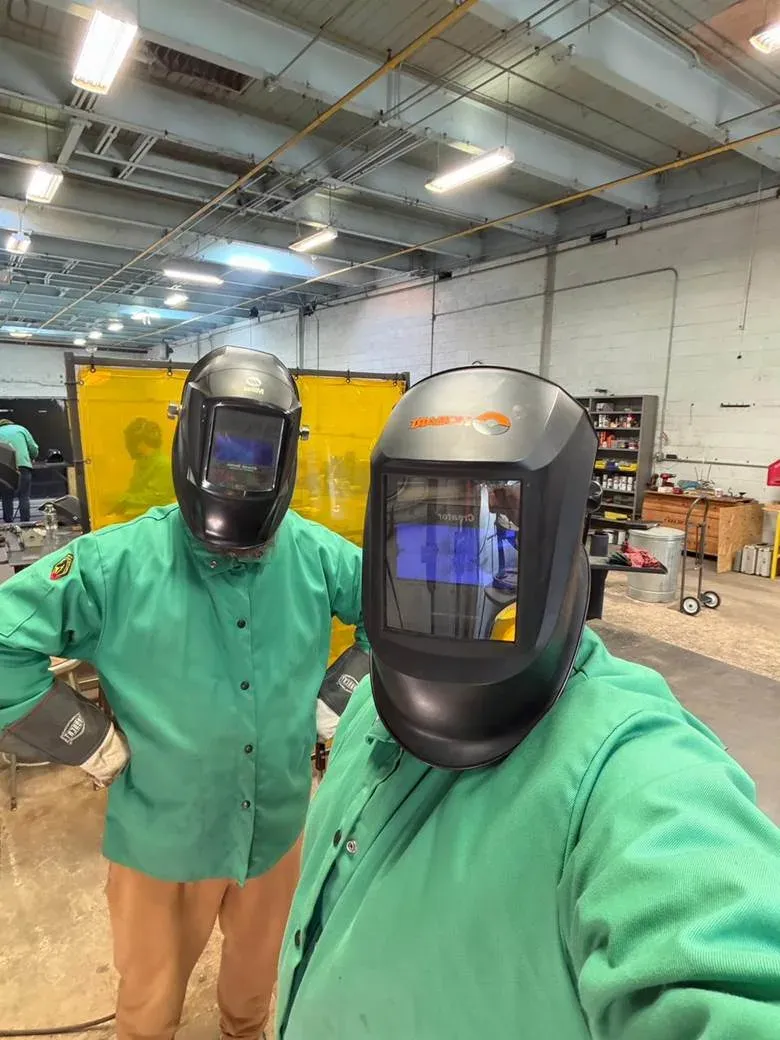
I found it both telling and beautiful.
Telling, because these are serious engineers. Not Luddites, not people afraid of new tools. People who have spent careers building systems that actually work. And they are reaching, intuitively, for something irreducible. Something that requires presence, understanding, and hands. Something that cannot be generated.
Beautiful, because it is exactly what Pirsig was talking about. Not the welding specifically – the impulse. The refusal to become a Sutherland.
This is the moment I decided to write this piece.
IV. The Plumbing Arc
Here is a thought experiment worth sitting with.

Roman aqueduct engineers were the systems architects of their civilization. Medieval master plumbers – the word comes from plumbum, Latin for lead – held knowledge that was rare, dangerous, and deeply respected. Victorian sanitation engineers essentially saved civilization from cholera. Then plumbing became infrastructure, then trade, then commodity.
Nobody panicked. The knowledge didn’t disappear – it stratified. Master plumbers still exist. They simply aren’t romanticized anymore.
I want to be clear: I have deep respect for plumbers, welders, electricians, and every engineer who works with their hands and their understanding simultaneously. What they do is complex, irreducible, and – as the AI era is beginning to demonstrate – increasingly valuable precisely because it cannot be abstracted away. A pipe that leaks announces itself. A system failure caused by an engineer who never understood what they were building can hide for years.
Software engineering is following the plumbing arc. But compressed into a decade instead of a century. The romanticized engineer of the 1980s and 1990s – the mysterious айтишник, as Russians say, that slightly condescending term normal people use for anyone who works with computers, implying something between a wizard and a repairman – is becoming commodity infrastructure. And AI is the catalyst.
Alex Karp, CEO of Palantir, said it plainly just days ago: “There are basically two ways to know you have a future. One, you have some vocational training. Or two, you’re neurodivergent.”
He is describing, in his blunt way, the same stratification. The people who will matter are those with irreducible skills – physical craft, or cognitive wiring that sees what others cannot.
What he didn’t say, but I will: neurodivergent engineers who also understand how things actually work at the level of first principles are not just surviving the AI era. They are the ones who will shape it.
V. What Actually Gets Lost

The conversation about AI and engineering tends to focus on jobs. That’s the wrong frame.
What gets lost is not employment. What gets lost is engineering intuition.
Not syntax. Not specific algorithms. Something that takes fifteen years to build and cannot be prompted:
- Feeling when a system is lying to you
- Knowing which simplification will cost you in eighteen months
- Reading a performance graph and smelling the cause before running diagnostics
- Knowing when something works for the wrong reason This intuition is built through friction. Through the almost physical pain of not understanding something and refusing to stop. Through what Pirsig calls gumption – молодецкий задор – the psychic fuel that keeps you at the problem when everything in you wants to walk away.
Andrey Konyaev @k, the mathematician and science communicator behind N+1, has a word for the accumulated result of all that friction: насмотренность. Literally untranslatable – somewhere between “trained eye,” “pattern literacy,” and “the wisdom of having seen enough.” A film director develops it by watching thousands of films. A master engineer develops it by building and breaking thousands of systems. It is not knowledge in the academic sense. It is recognition – the ability to see what is wrong, or right, or fragile, before you can fully articulate why. You cannot prompt for насмотренность. You can only earn it.
And through the moments when it finally clicks.
I was twelve when I discovered XOR. Not understood – discovered. There is a difference. Nobody handed it to me as a concept. I stumbled into it, and then spent hours following where it led – like pulling a thread that unraveled an entire hidden room. A single logical operation that could swap two variables without a temporary placeholder, encrypt with perfect symmetry using the very same operation to decode, compress images, find the one non-duplicate in an array in linear time. Each application felt like another door opening off the same impossible corridor.
The closest thing I can compare it to is the Zen koan of one hand clapping. Not the question – the moment after you stop trying to answer it rationally and something shifts. I walked familiar streets that evening and everything felt different. Not because the streets had changed, but because I was carrying a secret the visible world didn’t advertise. That is what genuine discovery feels like. That is насмотренность being born in real time. An LLM can explain XOR to you in thirty seconds. It cannot give you that evening.
Then there were pointer arithmetic. In his famous 2005 essay “The Perils of JavaSchools,” https://www.joelonsoftware.com/2005/12/29/the-perils-of-javaschools-2/ Joel Spolsky argued that pointers and recursion are the two concepts that many programmers never truly comprehend – but his sharper, more personal claim was about pointers specifically: that understanding them is not a skill but an aptitude, that most people seem to be born without the part of the brain that handles them. I found that both comforting and provocative. I struggled with pointers – not for long, but genuinely. The indirection, the addresses of addresses, the dereferencing – my brain resisted building that abstraction layer. Recursion, interestingly, came naturally to me. Pointers did not. I came back to them. And again. That is how I work with anything I don’t yet understand: I cannot let it go. I will return to a problem for days, months, years if necessary, until the click comes and the understanding is truly mine – not borrowed, not surface-level, not good enough to pass a test. This stubbornness may be connected to my neurodivergence. I have come to think of it as an asset.
I remember Maxwell’s equations resisting me for months. The frustration was almost physical. Then one day the field lines made sense, the curl and divergence resolved into something I could feel spatially, and the joy of that moment – I cannot compare it to anything else. New neural pathways, dopamine, myelination – whatever the mechanism, the experience is unmistakable.
The generation being trained entirely on AI outputs may never have that experience. Not because they’re less capable – but because the friction was removed before the intuition could form. The struggle is not the obstacle. The struggle is the mechanism.
VI. Be Fedro
Pirsig’s narrator carries within him an alter ego – Phaedrus, the philosopher he was before electroshock therapy erased his memory and a new consciousness emerged in his place. Phaedrus was obsessed with one question: what is Quality? – a word so hollowed out by corporate language since then that Pirsig would barely recognize it. “Quality time.” “Quality assurance.” “Quality product.” Phaedrus meant something else entirely: not a property of things, but the fundamental nature of reality that precedes the division between subject and object. The fact that the word has been drained of meaning is not incidental. It is precisely what he was warning against.
In Russian it might take two words to approach what he meant: суть and подлинность. The essence of a thing, and the authenticity of your encounter with it. **Суть **cuts through noise to what something really is. **Подлинность **asks whether your relationship with it is genuine – distinguishing the real from the imitation. Pirsig’s Quality lives in the tension between the two. You can’t have one without the other. A perfectly understood system built without care has суть but no подлинность. A passionate but confused engineer has подлинность but hasn’t reached суть yet. The click moment – when something finally resolves and you truly understand it – is when both arrive simultaneously. That is what Phaedrus was writing about.
He found it in the contact between a person and their work. The mechanic who actually cares is not performing maintenance. They are in relationship with the machine. That relationship – that Quality – is what makes the difference between a system that holds and one that fails at scale.
The engineers who will matter in the coming decade are the ones who choose to be Phaedrus. Who refuse disengagement. Who are willing to sit with not-understanding long enough for the click to come.
Here is my practical suggestion, for what it is worth:
Enroll in CS50. Harvard’s free introductory computer science course. It will not make you a programmer if you aren’t one. But it will give anyone – regardless of role – a felt sense of what computation actually is. What memory is. What an algorithm costs. https://www.youtube.com/@cs50
Draw a line pixel by pixel. Start with the line equation. Add smoothing. Watch aliasing appear and then disappear as you fix it. Understand that every image on every screen – every film frame, every UI element, every map tile – is someone’s loop running millions of times.
Trigger a buffer overflow intentionally. Feel the machine’s actual memory model under your fingers – and understand, viscerally, how malware works, why security vulnerabilities exist, and what every abstraction layer above you is quietly protecting you from.
Send and receive a raw TCP packet. Not through a library that abstracts everything away – manually, at the socket level. It is not as hard as it sounds, and what it gives you is vast: a felt understanding of handshakes, ports, headers, state, why the internet is shaped the way it is, and why half of all security vulnerabilities exist where they do. Suddenly HTTP, TLS, every network call your application makes – all of it becomes legible in a way it simply wasn’t before.
Implement a B-Tree by hand. Understand why databases are shaped the way they are.
Learn to make samogon. Or weld. Or fix a motorcycle. The domain is irrelevant. What matters is choosing, deliberately, to understand something end to end – from first principles to final result – without outsourcing the comprehension.
The cooling problem in a Nigerian distillery in forty-degree heat cannot be prompted. You have to understand the thermodynamics or you get nothing. That is the same skill as debugging a distributed system at three in the morning. The same intuition. The same молодецкий задор.
VII. The Survival Guide, One Paragraph
AI is an extraordinary tool. Use it. But if you never implement a linked list by hand, never struggle with a pointer until it clicks, never feel Maxwell’s equations finally resolve into something you can see – you will become an operator, not an engineer. Operators are always the first to be replaced by the next tool. Engineers understand what the tool is doing and why, which means they can work with any tool, evaluate any tool, and build the next one. The abyss between engineers and operators is not moral. It is cognitive. And it is growing.
Be Fedro. The motorcycle won’t fix itself. And neither will your understanding of it.