The Soyuz-Apollo of Innovation, Part 1: Dark Soviet TRIZ, Sunny Californian Design Thinking, and One Toilet Seat Cover
Two innovation frameworks invented on opposite sides of the Iron Curtain — and how to combine them into an actual mechanism for solving problems that shouldn't have solutions.
With gratitude to Анатолий Васильевич Локтионов, physics teacher at Physics-Mathematics Gymnasium No. 42, Barnaul – who introduced me to TRIZ when I was young enough that it rewired how I think permanently. One of the best things that ever happened to my brain. Thank you.

One of the corporate clichés I probably hate the most – with “Be agile!” taking a close second – is “Think outside the box!**”. Majority of times I heard this call from a leader, it was either completely ignored at best, or caused anxiety and panic attacks in those not lucky (or cursed) enough to have a neurodivergent brain like mine. When I hear that I picture an executive bellowing “THINK OUTSIDE YOUR BOXES!” at a room full of employees, some frozen, some quietly hyperventilating, all equally clueless about what exactly they’re supposed to do next.
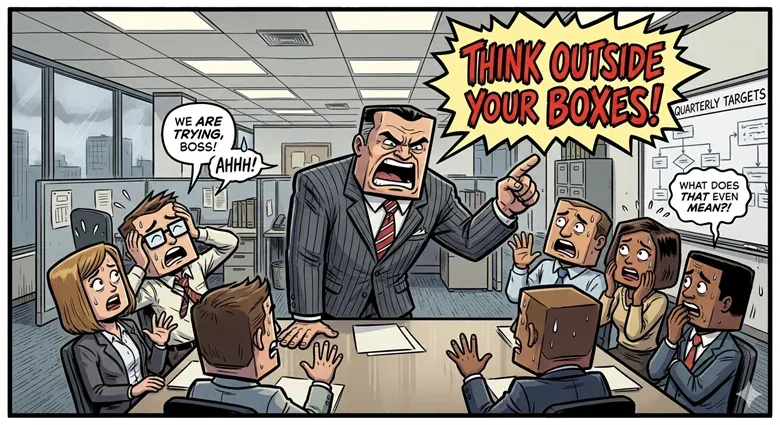
The problem isn’t motivation. Nobody in that room is deliberately thinking inside the box. The problem is that “think outside the box” is an instruction without a mechanism – like telling someone who can’t swim to “just don’t drown.” What if there were actual tools for this? Systematic, learnable, repeatable tools that don’t require you to be born with a misfiring dopamine system and a fondness for chaos?
There are. Two of them, invented on opposite sides of the Iron Curtain, and together they are the closest thing to a reliable “think outside the box” machine that humanity has produced. One is Soviet, empirical, and slightly terrifying in its rigor. The other is Californian, human-centered, and occasionally accused of being a glorified brainstorm with better Post-it notes. Both are genuinely useful. And combined, they’re something else entirely.

This is Part 1 of two. We’ll cover the theory, the history, and two practical examples – one from a Stanford professor, one from my jet-lagged brain at Half Moon Bay involving airport toilets. In Part 2, I’ll walk through a real business and engineering problem I solved using both frameworks – a system for anticipating customer calls before they happen, which ended up as a patent buried in the kind of language that makes you want to lie down in a dark room. We’ll translate it back into human.
Part 1: Half Moon Bay, a Stanford Professor, and a Toilet Seat
Half Moon Bay, California, good old days. One of those mornings where the Pacific is doing its best to make you forget you have a job.
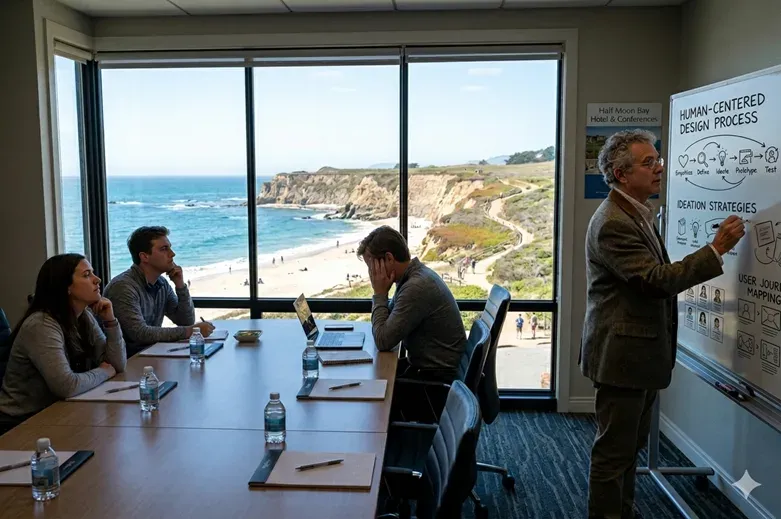
I was sitting in a hotel meeting room overlooking the bay, my brain neatly split in two: one half watching the water outside, already mentally underwater with the seals at Point Lobos the coming weekend, the other half attempting to track a lecture by a genuinely excellent Stanford professor on Design Thinking – empathy, diverge-converge, don’t jump to solutions, blah blah blah. Truly hard to follow when California is doing that outside the window. Jet lag wasn’t helping. Neither was the fact that I’d been treating coffee as a food group since 5am.
Then, out of a sudden, an hour-long practical task.
Improve or disrupt travel luggage. The setup: someone once had the brilliant idea of attaching wheels to a suitcase, making travelers’ lives dramatically less physically demanding (and simultaneously spawning a generation of people who buy annual gym memberships and show up twice). Our turn now.

My neurodivergent, jet-lagged, coffee-saturated brain received this brief and did what it does. Hold my Napa Valley Cab, brother. What follows is what I privately call the Siberian Berserk – that particular cocktail of dopamine, norepinephrine, serotonin, and probably several other neurotransmitters that don’t have names yet, flooding the system simultaneously. When this mode activates, you can’t confuse it with anything else: total clarity, the mind running in turbo, evaluating and synthesizing hundreds of ideas, patterns, and outcomes at once, seeing connections between things that are supposed to have nothing to do with each other. (In a separate article, I’ll write about how to harness this without driving yourself into complete exhaustion – decades of trial and error, some of it genuinely dangerous.)

I was spending most of my life on airplanes at that point. I knew exactly what travelers suffer. And the suffering that nobody was talking about – the one that didn’t make it into the professor’s brief – was airport toilets.
Specifically: airport toilets at airports that treat hygiene as optional. The anxiety of hovering over a public toilet seat at 2am somewhere between continents. The elaborate origami of toilet paper that achieves nothing. Nobody had asked me to solve this problem. Nobody told me I couldn’t.
Think outside the bag.
My solution: a toroid-shaped backpack that doubles as a toilet seat cover. The hole in the center is the toilet. The volume of the torus carries your carry-on essentials. One object. Two completely different functions. Zero additional items in your luggage.

The room’s reaction was a mixture of laughter, mild horror, and the particular silence that follows when someone has said something that is either completely stupid or completely right and nobody is sure which. The professor, to his considerable credit, gave it serious consideration.
Let’s give it some serious consideration here too – using both frameworks.
A Brief Detour to Soviet Engineering and Californian Sunshine
Before we dissect the luggage examples, some necessary history. Two methodologies, two very different worlds.
TRIZ: Soviet Precision Meets Inventive Genius

Зато, говорю, мы делаем ракеты / И перекрыли Енисей, / А также в области балета / Мы впереди, говорю, планеты всей! (“But at least, I say, we build rockets / And dammed the Yenisei, / And also in the field of ballet / We are ahead, I say, of the whole planet!”) – Юрий Визбор, Рассказ технолога Петухова, 1964
The Soviet Union was remarkable at producing things that could survive a nuclear blast and outlive three generations – like that meat mincer your grandmother still uses – and absolutely terrible at the kind of iterative, user-centered design that makes everyday life bearable.
TRIZ – Teoriya Resheniya Izobretatelskikh Zadach, or Theory of Inventive Problem Solving – was born in 1946 in the patent department of the Soviet Navy in Baku, Azerbaijan. A twenty-year-old engineer named Genrich Altshuller was reviewing invention proposals, and he noticed something: the best inventions all solved the same structural type of problem. Not the same content – but the same shape. Someone, somewhere in a completely different field, had already encountered and solved a version of your problem. The knowledge existed. It just wasn’t connected.
Altshuller spent decades analyzing hundreds of thousands of patents, extracting the underlying patterns. His core finding: almost all inventive problems reduce to contradictions – improving one parameter inevitably degrades another, and there are only 40 fundamental principles by which human beings have ever resolved them. Forty. Across all of engineering, across all of history.
The Soviet government’s reaction: they arrested him and sent him to the Vorkuta Gulag. Stalin dying in 1953 led to his release the following year. He went straight back to work – which is perhaps the most TRIZ thing that has ever happened.
TRIZ gives you 40 inventive principles, 76 standard solutions, a contradiction matrix, and the Ideal Final Result – the imagined solution that works perfectly while consuming zero resources and creating zero new problems. Empirical, systematic, steep learning curve.
http://altshuller.ru/world/eng/index.asp
Design Thinking: How Designers Actually Think

A side note for Russian speakers: the term “Design Thinking” is genuinely terrible in translation. “Дизайн” in Russian means visual aesthetics – interiors, logos, fonts. So a Russian speaker hears “Design Thinking” and pictures an interior decorator having a particularly creative morning. I believe that the most accurate translation is actually проектное мышление – thinking like an engineer-designer, someone who conceives and develops solutions from scratch. Or, to put it plainly: думать как проектировщик, не как декоратор. Keep that in mind as we go.
Probably one reason the USSR collapsed – and I say this with only partial sarcasm – was a complete absence of empathy in the design of everyday things. When you optimize entirely for engineering parameters and ignore the human being who has to live with the result, you get products that are technically impressive and humanly miserable. The Soviet state was running pure TRIZ with zero Design Thinking. The lesson wrote itself across an entire civilization.
Design Thinking emerged from a simple observation: professional designers think differently. They don’t analyze their way to a solution – they build something rough, test it against reality, and let understanding emerge from making. In 1969, Nobel laureate Herbert Simon formalized this in The Sciences of the Artificial. Stanford’s Rolf Faste made it teachable in the 80s and 90s. David Kelley took it to business, founded IDEO in 1991, then co-founded the Stanford d.school. The rest is a thousand corporate workshops and a global Post-it note shortage.
Five stages: Empathize, Define, Ideate, Prototype, Test. The critical move is that the problem definition and the solution evolve together – you don’t solve the stated problem, you find the real one.
Now Back to the Luggage
The Professor’s Example: Wheels
Through a Design Thinking lens: Someone observed real travelers – not “business travelers aged 25-55” as an abstraction, but actual exhausted humans dragging bags across marble airport floors. The empathy insight: the problem isn’t bag weight. It’s the effort of moving the bag. The problem was redefined from “make it lighter” to “reduce the effort of transport.” That reframe opened the solution space. Wheels.
Through a TRIZ lens: Classic Principle 5 – Merging: combining a static storage system (the bag) with a transport mechanism (wheels) in the same physical space. The underlying contradiction: the bag must be stable and hold its shape (to pack) AND it must be mobile (to travel). TRIZ Separation Principle resolves this by separating functions – the bag is stationary when packed, mobile when moving. The wheels are only active in one of the two states. The Ideal Final Result: the bag moves itself, with minimum added complexity.
Level of inventiveness on Altshuller’s 1–5 scale: Level 2. A good improvement to an existing system. Common knowledge in hindsight, which is how you know it was a real insight at the time.
My Example: The Toroid Toilet-Cover Backpack
Through a Design Thinking lens: I rejected the stated problem. The professor said “improve luggage.” The real question was: what do travelers actually suffer? Empathy – drawn from lived experience rather than user interviews, which is a shortcut the method technically discourages but which the ADHD brain performs automatically and compulsively – surfaced a pain point nobody in the room had articulated: the hygiene anxiety of public toilet seats. Problem redefined. New solution space opened.

The “five crazy ideas” phase of DT ideation explicitly asks for ideas that seem absurd, illegal, or impossible. A backpack shaped like a toilet seat cover is exactly the kind of idea that should emerge from genuine divergent thinking, get put on the board without judgment, and then get examined seriously. Most rooms don’t actually do that. They call it ideation and practice polite brainstorming. The Siberian Berserk is the solo, unfiltered version.
Through a TRIZ lens: This is where it gets precise.
Principle 5 – Merging again, but at a higher level: not combining existing components (bag + wheels) but combining entirely separate systems (carry-on luggage + toilet hygiene solution) that operate in different contexts for the same person.
Principle 6 – Universality: one object performs multiple functions, eliminating the need for a separate dedicated object (the disposable toilet seat cover now absent from your toiletry bag).
Principle 7 – Nesting (Matreshki, Traditional Russian Dolls): this is the key move. The function isn’t added to the bag – the bag’s geometry becomes the function. The toroid shape means the hole is the toilet seat opening. Form and function are unified in the shape itself, not bolted together.

Trimming: TRIZ trimming removes a component from a system by transferring its function to something that already exists. The toilet seat cover – a standalone object, usually a flimsy paper thing that achieves psychologically more than hygienically – is trimmed entirely from the system. Its function migrates to the luggage.
Physical contradiction resolved: luggage must have volume (to carry belongings) AND must be flat/conforming (to cover a toilet seat). A conventional bag cannot do both. The toroid resolves the contradiction without compromise – the volume is in the ring, the flatness is in the hole. Both requirements satisfied simultaneously, neither degraded.
On Altshuller’s scale: Level 3–4. A solution that redefines the system boundaries by resolving a contradiction that wasn’t even stated in the original problem.
So What’s the Actual Mechanism?

Here’s the answer to the question “think outside the box” never provides.
Design Thinking gets you to the right problem. TRIZ gets you to a non-obvious solution to that problem. Used separately, each has a critical weakness: DT is powerful at empathy and problem framing but can be vague and subjective at the solution generation phase – it tells you to ideate wildly but doesn’t give you a systematic way to find ideas that aren’t obvious. TRIZ is powerful at generating non-obvious solutions but starts from a problem that’s already technically formulated – it has no mechanism for discovering what the real problem is in the first place.
Together: DT handles the upstream (finding the real problem, understanding the human), TRIZ handles the downstream (resolving the contradiction with inventive principles). The handoff happens at the moment you can write a clean problem statement with a specific contradiction in it. That’s when you stop DT and start TRIZ.
Nobody in a corporate workshop will give you this. They’ll give you Post-it notes and tell you to think outside the box.

In Part 2: a real business problem – how do you prepare a customer service agent for a call before the customer even knows they will make a call? The solution turned into a patent, written in the kind of language that would make Altshuller weep. We’ll decode it, and show exactly which DT and TRIZ principles made it work. Stay tuned.