A Man Without a Built-In LLM
Reading Susan Schaller's account of Ildefonso — a man who reached 27 without ever learning a language — and what it reveals about cognition, AI, and the internal monologue we take for granted.
![[man-without-llm.webp]] While another technical article is cooking, here’s a more philosophical post as I finished reading A Man Without Words by susan schaller, which I came across thanks to Frank Lineker Rocha’s question: “If a person is born deaf and never learned a language/idiom, how does that person think?”
I was thinking about neuroplasticity (Eagleman’s The Brain: The Story of You was still fresh from a couple years ago), visual thinking, sign language development, etc. Instead, I found myself reading about Ildefonso, a 27-year-old deaf Mexican man in Los Angeles, who had never learned any language at all. No sign language. No written language. No shared symbolic system of any kind.
Susan Schaller, teaching a sign language class, encountered him and spent months trying to crack through. The book documents that process - the frustration, the false starts, the moment when Ildefonso finally grasped that things have names, that symbols can represent reality. It’s like watching someone’s neural network train in real-time: repetition, pattern recognition, starting with concrete examples (numbers, objects you can point to), waiting for that breakthrough when the model suddenly generalizes.
But here’s what grabbed me: what was it like before?
Living Without the Internal Monologue
We all walk around with an internal language model constantly running. That voice narrating your decisions, planning your next meeting, categorizing what you see, rehearsing conversations, judging situations. It’s so constant, people often don’t even notice it’s there.
Ildefonso had none of this.
No internal monologue. No words forming in his mind. No verbal thought at all. He experienced reality directly - images, sensations, spatial relationships, sequences of events like mental movies. The cat wasn’t “cat” - it just was. Tomorrow and yesterday weren’t distinct temporal categories - just a vague sense of cycle and memory.
Think about what that means. Every strategic thought you have, every problem you solve by “thinking it through,” every plan you make - all of that runs on language. Strip it away and you’re left with immediate perception, pattern recognition, emotional response. Powerful in its own way, but fundamentally different.
The Accidental Buddhist
Twenty years ago I obsessed over Zen Buddhism. Read The Iron Flute koans, tried to wrap my head around teachings that deliberately resist verbal capture. One stuck with me: when you name something, you lose it forever. The moment you label the thing, you’re no longer experiencing the thing itself - you’re experiencing your concept of it. You see the word, not the reality.
Ildefonso was living this teaching. Not as spiritual practice, not as philosophical exercise, but as the only mode available to him. The ultimate beginner’s mind - experiencing each moment fresh, without the conceptual overlay that language provides.
And yet. Schaller describes his life before language not as enlightened presence but as frustrating. Limited employment options. Easily exploited. Unable to plan effectively or advocate for himself. Sensing that others had access to something invisible that organized the world in ways he couldn’t grasp.
But Here’s What Haunted Schaller
By the end of the book, Ildefonso has learned ASL and found work as a gardener at a hospital. When he explains his work - how the gardens help doctors and patients, how the plants and green spaces create healing environments - he’s not just reciting job duties. He’s describing a direct, unmediated connection between his work and its impact on human wellbeing.
The monk didn’t disappear when language arrived. If anything, he integrated both modes.
But Susan worried. Had she done harm by giving him language? Had she taken something precious - that direct experience of reality - and replaced it with the conceptual overlay the rest of us carry? The question clearly troubled her, and she leaves it unresolved.
I think she was seeing something real. Language does create distance from immediate experience. But maybe Ildefonso shows us it doesn’t have to be an either/or. He gained the ability to plan, advocate, coordinate - and kept the ability to experience his work without the filter fully taking over.
When the Map Becomes More Real Than the Territory
Here’s where it connects to how we lead organizations.
Every strategic planning session is people with internal LLMs talking to each other, generating verbal models of reality. “Customer-centric.” “Agile transformation.” “Data-driven culture.” “Digital transformation.” “Synergy.” “Innovation ecosystem.” “Best-in-class.” “Stakeholder engagement.” “Future-ready.”
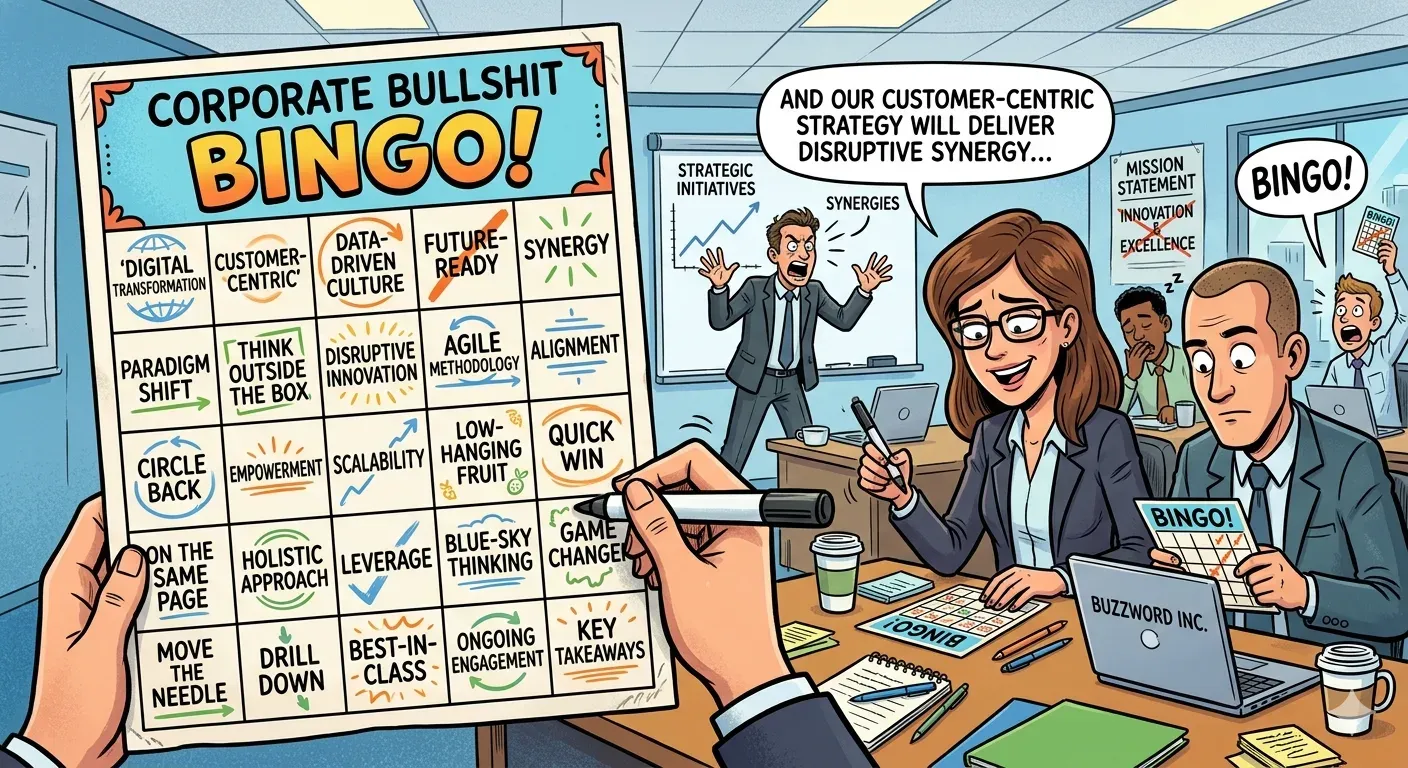
These are labels - useful abstractions that help us coordinate and plan. Good concepts, even. Until they become corporate bullshit bingo within about six months of being introduced. The organization underneath keeps doing what it actually does, regardless of what we call it or which consultant-approved framework we’re currently worshipping.
The architecture diagrams versus how data actually flows through the system. The org chart versus how decisions actually get made. The implementation plan versus what the team actually needs to get work done. The “transformation roadmap” versus the actual humans trying to figure out why the new system is slower than the old one.
We build dashboards that measure signals and proxies. But at what point does the dashboard become more real to leadership than the actual humans doing the work?
Some executives experience conceptual overlay without reality. “Revenue growth” is a number on a slide; the customer buying is a human decision in a specific moment. “Employee engagement” is a score from a survey; the person showing up Monday morning is lived experience that can’t be fully captured by a Likert scale. “Digital maturity” is a quadrant on a consultant’s deck; the developer is fighting with legacy code that nobody wants to touch.
We’re so busy naming and measuring we forget to look.
Borders Are Just Lines We Agreed to Believe In
I see this tension at home. My kids travel between São Paulo and Moscow from time to time. They speak Portuguese, Russian, English - languages are just tools for talking to different people, not identities to defend.
I tried explaining the concept of “country” and “borders” to them once. Complete failure.
To them, these are just different places with different people. They don’t experience “foreign” - just different contexts that require different languages. Meanwhile, adults draw lines on maps, create passport requirements, build entire identities around which side of the line you were born on, and call all of it real.
Dual-citizenship trilingual kids prove that borders are conceptual constructs, yet organizations obsess over “local versus global” as if these categories exist in nature.
The Dangerous Comfort of Labels
Don’t misunderstand - language gives us tremendous power. You can’t align distributed teams without shared vocabulary. You can’t build enterprise systems without agreed-upon definitions. Ildefonso gained agency, autonomy, and dignity through learning ASL.
But the label becomes a trap.
Once you categorize someone as a “low performer,” you stop seeing their actual work - you see the category. Once you label a project “failing,” you stop noticing what’s actually working. The frameworks we use for understanding organizational dynamics - powerful for pattern recognition, but dangerous the moment we forget these are models and start seeing categories instead of humans displaying behaviors in specific contexts.
What Ildefonso Teaches Leaders
Ildefonso’s breakthrough - that moment when he finally understood that everything has a name - was simultaneously liberation and constraint. But what makes his story powerful is that he seemed to maintain both: the ability to use language as a tool and the ability to experience his work directly, without the conceptual filter fully taking over.
The leader’s challenge: learn to toggle.
Use the strategic framework, then go look at the actual work. Read the dashboard, then talk to the human. Build the model, then test it against reality. This isn’t mystical - it’s practical. Your best technical decisions probably came when you weren’t thinking in frameworks, when you were directly engaged with the problem. Your worst probably came when you trusted the model more than the reality it was supposed to represent.

The Question
Susan Schaller and Ildefonso didn’t give up through months of failure - her trying to teach, him trying to grasp what she was attempting to convey. They stayed connected to the reality of their shared struggle, not just the concept of teaching and learning.
When did you last experience your organization without the verbal overlay? When did you last see the work instead of the workflow diagram? When did you last encounter a person instead of a performance rating?
The internal LLM is incredibly powerful. It lets you plan, abstract, coordinate, build systems that span continents and time zones.
But sometimes the most sophisticated thing you can do is shut it off.
And just look at the cat.